The Complete Guide to Hard Money Loan Fees in California
Fast Approval. Faster Funding.
Funded
Not a broker
Rating on Google
Don’t Get Overcharged: Hard Money Loan Fees Simplified (Origination Points, Junk Fees & More)
Hard money loans are the gold standard for investors who need speed and flexibility in asset-based financing.
When time is of the essence, and investors are in a hurry to close a deal, they might gloss over the fine print or skip reading it altogether.
But remember, small details can cause big problems, and fees on a million-dollar loan can reach into the tens of thousands of dollars, so you need to understand which fees are legitimate and which are excessive.
Therefore, it is critical for investors to understand a typical hard money lender’s fee structure, junk fees to look out for, and the best ways to avoid being overcharged.
What are Hard Money Loan Fees?
Hard money loan fees are the costs lenders charge to provide short-term, asset-based financing. These fees cover the lender’s risk, processing time, and the fast turnaround that hard money loans are known for. Common fees include origination points, underwriting fees, appraisal costs, document fees, and interest charges.
Most hard money lenders structure their pricing with the interest rate, prepayment penalties, and fees as separate entities, and understanding the difference helps you calculate the true cost of the loan.
Standard Hard Money Loan Fees
The borrower is responsible for the following fees.
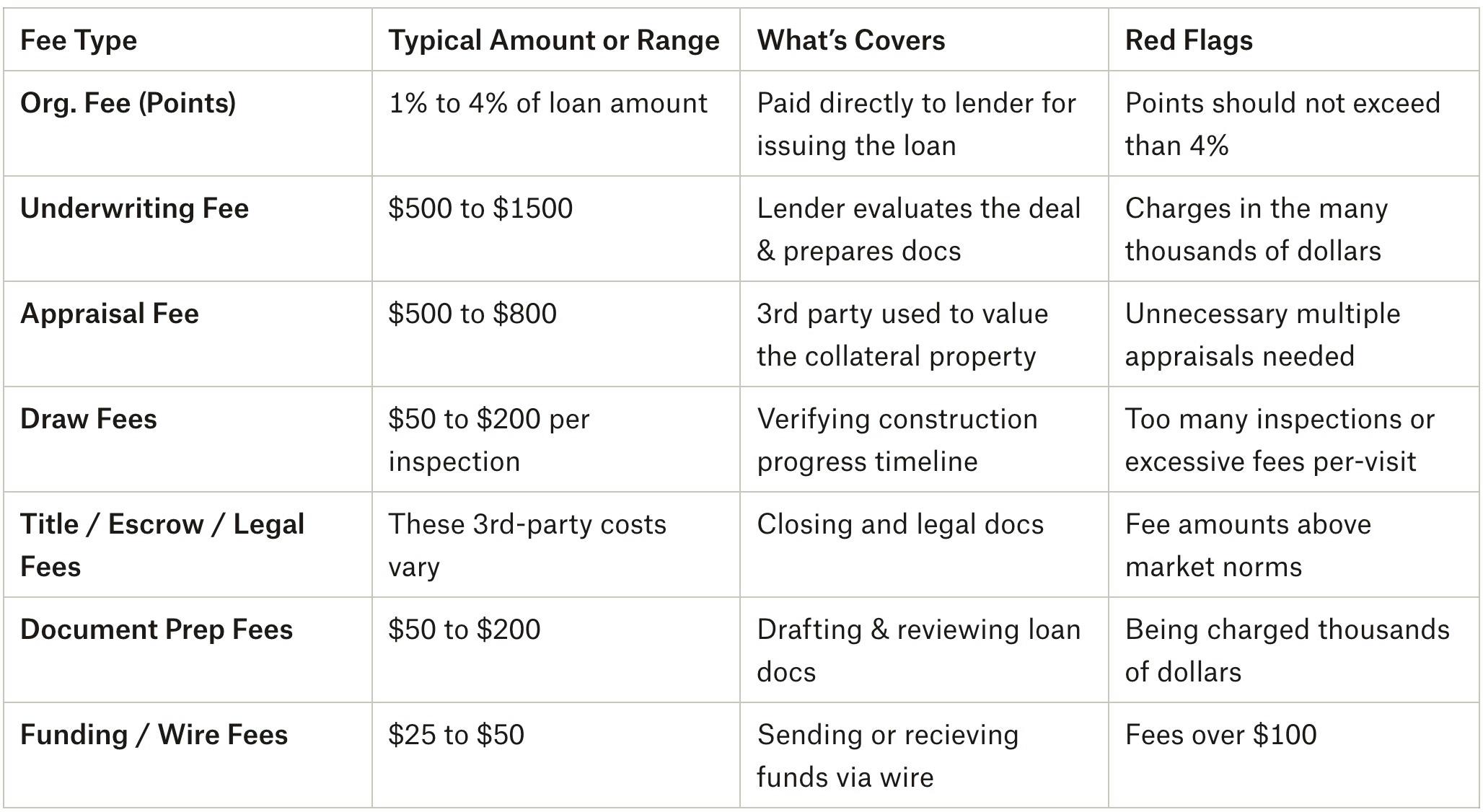
Origination Fee (aka points)Origination fees and points are interchangeably used; they are a percentage of the loan amount, which is charged for issuing the loan.
For example, if you get a 100K loan and the lender charges 3 points, you will pay 3K to the lender. This is the lender’s compensation for underwriting the loan.
Fees vary lender by lender, but for smaller loans under $500,000 expect to pay more points, whereas loans over $1 million see the fees start to drop.
Under most circumstances, large loans equate to fewer origination points.
Underwriting FeeCosts related to evaluating the deal and preparing documents. Usually, this fee is non-refundable because if the borrower pulls out of the deal, the lender still needs to be compensated for their time spent reviewing the deal.
Appraisal or Valuation FeesA lender will often hire a 3rd party appraisal company to determine the value of collateral property. This gives the lender assurance that the property is correctly valued and supports the loan-to-value ratio. It’s important to note that the borrower will be responsible for this fee.
Inspection Fees or Draw FeesThese fees are common for rehab or construction loans. Every time you request a draw, the lender will send an inspector to the property site to verify that the construction work is on schedule. This protects the lender by ensuring funds are released only after confirmation that the project is progressing.
Title, escrow, and legal feesThese are all standard 3rd party fees related to closing costs.
- Title: Used for verifying and insuring the property’s title
- Escrow: Managing the transfer of funds
- Legal: Handling the legal documentation
Junk Fees to Watch Out For
While many hard money loan fees are legitimate, some lenders add unnecessary or inflated charges to boost their profit.
These are commonly referred to as “junk fees,” and they can dramatically increase the cost of your loan if you’re not paying attention.
Here are the most common ones to look out for:
Excessive Processing or Administration FeesSome lenders charge large “processing” or “admin” fees that don’t actually correspond to any real service. A small administrative charge can be normal, but anything unusually high (say more than a few hundred dollars) should be questioned.
Overpriced Doc Prep FeesPreparing loan documents does take time, but it shouldn’t cost thousands of dollars. If you see a high doc prep fee, ask exactly what you’re being charged for.
Extra Review or Compliance FeesSome lenders tack on review fees, compliance fees, or other vaguely named charges. These often overlap with underwriting and should already be covered.
Funding or Wire FeesA small wire fee is standard, usually around $25 to $50 per transfer. But some lenders inflate this cost far beyond what it actually costs to send a wire. Anything beyond a minimal cost should be a red flag.
“Expedited” or “Priority Funding” FeesIf a lender charges extra just to process your loan in a reasonable timeframe, look for another lender. Fast turnaround is already part of the value hard money lenders advertise afterall, speed is one of the main reasons investors use hard money loans.
Duplicate Fees That Don’t Make Sense TogetherFor example, being charged both an underwriting fee and a “review fee” that covers the same work. If two fees sound similar, if you see this, be sure to ask what each one covers.
Typical Hard Money Loan Fees in California
How to Protect Yourself from Price Gouging Fees
Not all hard money lenders are out to get you, but like any industry, there are a few bad apples.
The most effective way to ensure your fees are fair and your hard money loan costs under control is to ask questions, be proactive, and stay informed.
Use a Direct Local Lender
By using a direct local lender and not a broker, you will avoid paying brokers fee, which can amount to thousands of dollars in savings. Additionally, local lenders are more knowledgable when it comes to real estate prices and will provide better service since they are the decision-makers.
Shop Around
Contact 2 to 3 direct local lenders in your area to compare fees and terms, but never settle on the first lenders offer. Some lenders will offer lower interest rates but higher points, while other lenders may offer the inverse. Use a hard money lending calculator to better understand the total cost of your loan to choose the correct lender for you.
Avoid National Call-Center Lenders
Large nationwide lenders often charge higher or hidden fees and have a rotating team of call-center reps, not a single decision maker. This can cause miscommunication or delays potentially jeopardizing your deal.
Ask About Refundable vs. Non-Refundable Fees
Some fees, like underwriting or application fees, may not be returned if the loan doesn’t close at the last minute, so make sure to get clarification upfront.
Question Any Vague or Unusually High Charges
Inquire about any extra miscellaneous fees labeled as “administration,” “processing,” or “document prep.” These should be clearly explained and anything excessive is a red flag.
Ask for a Complete Final Breakdown of Fees
Finally, always ask for a detailed fee breakdown before running your credit or paying any upfront costs like the appraisal fee.
Understanding exactly what you’re being charged for helps you spot unnecessary or inflated fees and ensures you’re making a smart financial decision.