2026 California Hard Money Loan Interest Rates
Fast Approval. Faster Funding.
Funded
Not a broker
Rating on Google
Understanding hard money loan interest rates in California is essential for any real estate investor looking to move quickly in a competitive market.
These loans offer speed, flexibility, and access to capital that traditional lenders often can’t match, but that convenience comes with higher, risk-based pricing.
In California, interest rates typically range from 9% to 14%, depending on factors like property type, loan-to-value ratio, borrower experience, and overall market conditions.
Whether you’re funding a fix-and-flip, bridge loan, or long-term investment strategy, knowing how these rates work can help you structure stronger deals, avoid surprises, and secure the best financing available.
2026 California Hard Money Loan Interest Rates
As we close out 2025, most California hard money lenders offer the following rates:
- First-position loans: typically 9% to 11%
- Second-position loans: generally 12% to 14%
Since California has some of the most desirable real estate in the world, it comes as no surprise that it also has the highest concentration of hard money lenders ready to fund investor deals in the nation.
California’s real estate market is viewed as strong, stable, and fast-moving, which lowers the perceived risk for lenders and allows them to offer more aggressive and competitive interest rates.
This competition among lenders further drives pricing down, giving investors access to some of the most favorable hard money terms available.
Because of this, hard money loan rates in California tend to be lower than the rest of the country.
Factors That Determine Your Hard Money Loan Interest Rate
Property (Condition, Location, and Type)
Hard money loans are collateralized asset-based loans where real estate is used to secure the debt; therefore, it should be no surprise that a property’s condition, location, and type play a major role in the interest rate your hard money lender is willing to offer.
Because these factors can vary dramatically from one property to another, lenders adjust their loan parameters to match the specific risk profile of each deal.
For example, you can generally expect a lower interest rate for single-family homes, condos, or multi-family properties, and higher rates for land, construction projects, or rural properties.
Likewise, properties in prime markets such as Los Angeles, Orange County, or the Bay Area are much easier to sell than those in rural, unknown, or unstable markets like Bakersfield or Kings County.
A property in great condition as opposed to one that is dilapidated will also be easier to sell since it is immediately usable.
These factors are crucial to the hard money lender because if the borrower defaults and foreclosure is necessary, a well-located, good-condition property in a prime location will be much easier to sell, even if the economy or housing market goes south.
Loan-to-Value (LTV) Ratio
The loan-to-value ratio measures how much the lender is financing relative to the property’s appraised value, ie, how much “skin in the game” the borrower has.
It’s also a major driver of interest rates: the higher the LTV, the greater the perceived risk, and the lower the LTV, the safer the loan appears to the lender.
Examples:
- LTV under 60% = best rates on the market
- LTV 60% to 70% = standard rates
- LTV 70% to 75% = increased rates
A lower LTV means that if the borrower defaults, the lender has more room to recover their investment capital, hence the lower rate.
Borrower’s Risk Profile
Though this is not as important as the actual property or LTV, it can still affect the interest a borrower ultimately pays.
Lenders assess the borrower's risk, including credit history, financial stability, and real estate investment experience.
And of course, riskier borrowers typically face higher interest rates.
Borrowers with strong credit and a diverse portfolio of financial assets signal reliability and lower default risk, often attracting competitive offers from multiple lenders eager to win their business.
Deal Complexity
The complexity of the deal also plays a role in the interest rate a borrower receives. The more moving parts involved, the higher the perceived risk for the lender, which usually translates into higher rates.
Complex or difficult deals often include:
- Heavy rehab projects
- Ground-up construction or ADU builds
- Title issues or unresolved liens
- Multiple borrowers, entities, or layered ownership structures
These types of deals require more oversight, more time, and more risk tolerance from the lender.
On the other hand, simple purchase loans or straightforward refinances tend to receive the best rates because they are easier to underwrite, faster to close, and carry fewer unknowns.
Loan Position
As discussed in our breakdown of 1st liens vs. 2nd liens; second-position loans carry significantly more risk for hard money lenders. In a foreclosure, the first-position lender is paid in full before the second-position lender receives anything, which makes the junior lien inherently riskier.
This difference in risk has a major impact on pricing, and the rate ranges for each position are dramatically different. In California, first-position loans typically range from 9% to 12%, while second-position loans usually fall between 12% and 14%.
Market Conditions
As we’ve discussed so far, hard money lenders base their rates on risk, and broader macro market conditions also play a major role in shaping that risk. Broadly speaking, five key types of market conditions influence how lenders price their loans.
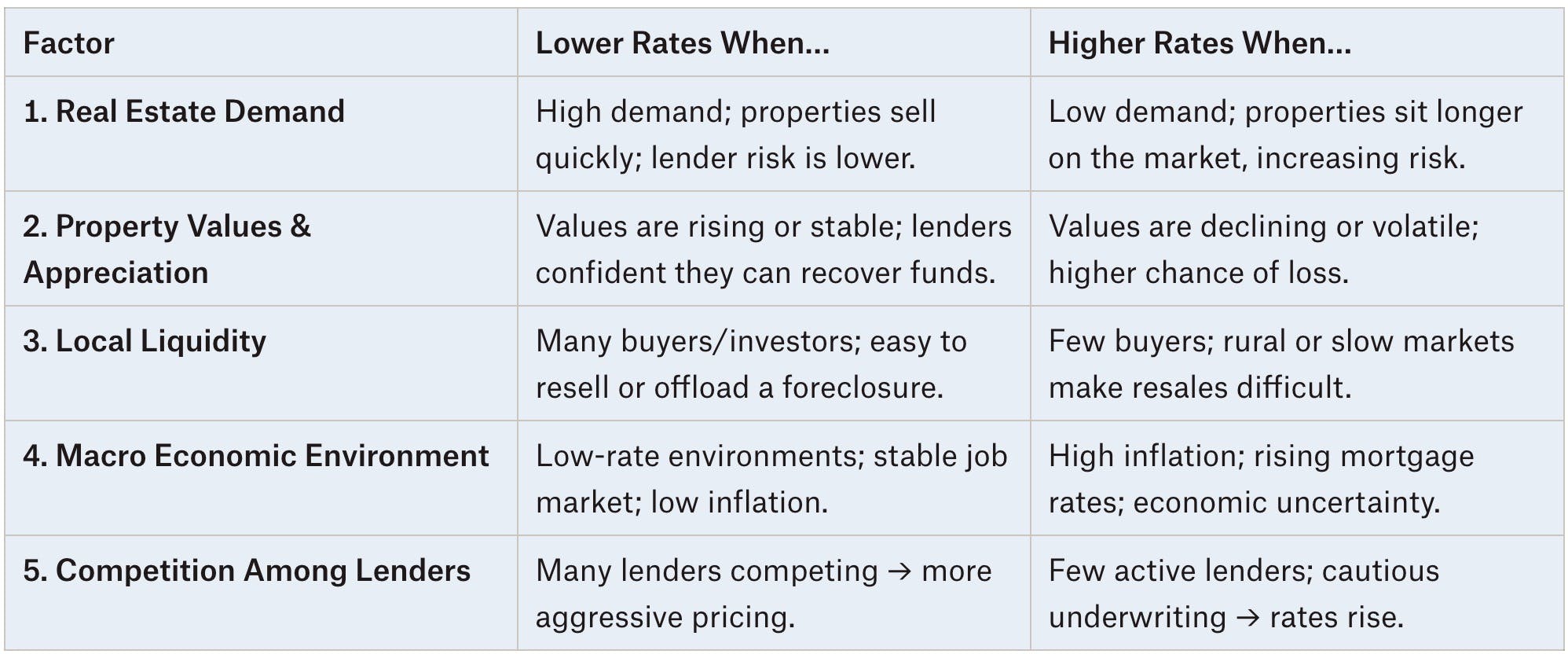
Hard Money Interest Rates in California
What is the interest rate on a hard money loan in California?
In 2026, California hard money loans’ interest rates typically range from 9% to 14%, depending on factors like the property, loan-to-value ratio, borrower experience, market conditions, and lender competition. Rates can be higher for riskier deals or unique property types.
How do hard money loan interest rates compare to traditional bank loan rates?
Hard money loan interest rates are generally higher than traditional bank loans because they are short-term, asset-based loans with higher risk.
While conventional bank loans often range from 5% to 8%, hard money loans usually range from 9% to 14% in California, depending on the property, loan-to-value ratio, and borrower profile.
The higher rate reflects the speed, flexibility, and accessibility of hard money funding, which is ideal for investors who need quick capital or have unique properties that banks may not finance.
What factors affect the interest rate I’ll receive on a hard money loan?
Hard money loan interest rates are typically determined based on risk factors, loan terms, and market conditions rather than just your credit score. Lenders consider:
- Loan-to-Value (LTV) Ratio: Higher LTV = higher risk = higher rates.
- Property Type & Condition: Fixer-uppers or unusual properties may carry higher rates.
- Borrower Experience: Experienced investors may get lower rates.
- Market Conditions: Competitive or high-demand markets can lower rates; slower or riskier markets can raise them.
- Loan Term: Short-term loans often have higher interest rates than longer-term loans.
Essentially, lenders price the loan to balance potential profit with the risk of the investment.
Can I negotiate the interest rate on a hard money loan?
Yes. While hard money rates are generally higher than traditional loans, you can sometimes negotiate based on factors like your experience, financial strength, property quality, and deal simplicity. Presenting a lower-risk loan can encourage lenders to offer a more competitive rate.
Do property type and location influence hard money loan interest rates?
Absolutely. High-quality, well-located properties, like single-family homes or multi-family units in prime markets, usually get lower rates. Riskier properties, such as land, construction projects, or rural locations, are harder to sell if the borrower defaults, which typically leads to higher interest rates.
How does the loan-to-value (LTV) ratio impact my interest rate?
LTV measures how much of the property’s value the lender is financing. Lower LTV ratios reduce the lender’s risk and often result in lower interest rates. Higher LTV ratios increase risk, meaning the lender may charge a higher rate to protect their investment.
How are hard money loans’ interest rates calculated?
The vast majority of hard money loans are interest-only, meaning you pay only the interest each month while the principal remains unchanged. The interest rate determines your monthly cost.
Example:
A loan for $200,000 at 10% interest-only for 12 months means the borrower will pay $20,000 in interest over the year, and the $200,000 principal is due at the end of the loan term.
Handpicked Resources
Hard Money Guide Hard Money
The Ultimate Guide to Hard Money Loans Hard Money
How To Find The Best Hard Money Lender in California Bridge Loans
Bridge Loans' Rates & Fees Hard Money
Why Choose a Local Hard Money Lender in Los Angeles Hard Money
Hard Money Lenders for Business Acquisitions